EMERYVILLE, Calif., August 17, 2026
Key Takeaways
- Amyris researchers built a modular precision fermentation platform which enables rapid production of sesquiterpenes, delivering high-purity materials not available through conventional production methods.
- Collaborators at the Naval Air Warefare Center, Weapons Division (NAWCWD) and the Air Force Research Laboratory (AFRL) tested these molecules across a variety of performance applications, including advanced optical materials, aviation fuels, and elastomers.
- Applications testing showed these biomanufactured building blocks can match, or in some cases exceed, the performance of conventionally produced counterparts.
- The results show the potential of biological chemistry in expanding the viable chemical space for sustainable materials discovery and design.
Today, Amyris and scientists from NAWCWD and AFRL published a new peer-reviewed study in the Royal Society of Chemistry journal Green Chemistry, evaluating sesquiterpenes across defense-related material applications.
With their structural diversity and unique chemical properties, materials scientists have long theorized about the potential of sesquiterpenes across applications. However, sourcing them at the purity and scale needed for testing has been a persistent barrier. Moreover, there was little impetus to seriously investigate these applications before a technology existed that could deliver reliable, industrial-scale sourcing.
Biotechnology as a tool for materials innovation
This changed in the last 15 years, when Amyris demonstrated robust, high-purity, commercial-scale production of numerous sesquiterpenes, reviving interest in the potential of sesquiterpenes in materials applications.
"Synthetic biology is a powerful technique to produce novel molecules that can be challenging to synthesize via conventional synthetic chemistry," said Ben Harvey, Chief Scientist for High-Performance Fuels and Composites at the Naval Air Warfare Center, Weapons Division (NAWCWD), and co-author of the research article. "The unique functionality of bio-based molecules can be used to generate new fuels and polymers that outperform conventional materials."
"Synthetic biology is a powerful technique to produce novel molecules that can be challenging to synthesize via conventional synthetic chemistry." - Ben Harvey, SSTM Distinguished Scientist at the Naval Air Warfare Center, Weapons Division (NAWCWD)
In the new Green Chemistry publication, titled "Use of a Synthetic Biology Pipeline to Rapidly Generate Sesquiterpenes for Chemical Applications Testing," Amyris scientists describe a modular production platform for high-titer sesquiterpene production, enabling rapid generation of high-purity samples for further applications testing. "The pipeline we built on Amyris' core infrastructure enabled us to go from synthase selection to purified, decagram quantities for applications testing in as little as 90 days," said Simone Mantovani, senior scientist and lead author of the article. "Several of the compounds are not previously available through conventional production methods at any relevant quantity, demonstrating how biotechnology is increasingly relevant as a tool for materials innovation."
Enabling differentiated performance through bio-based building blocks
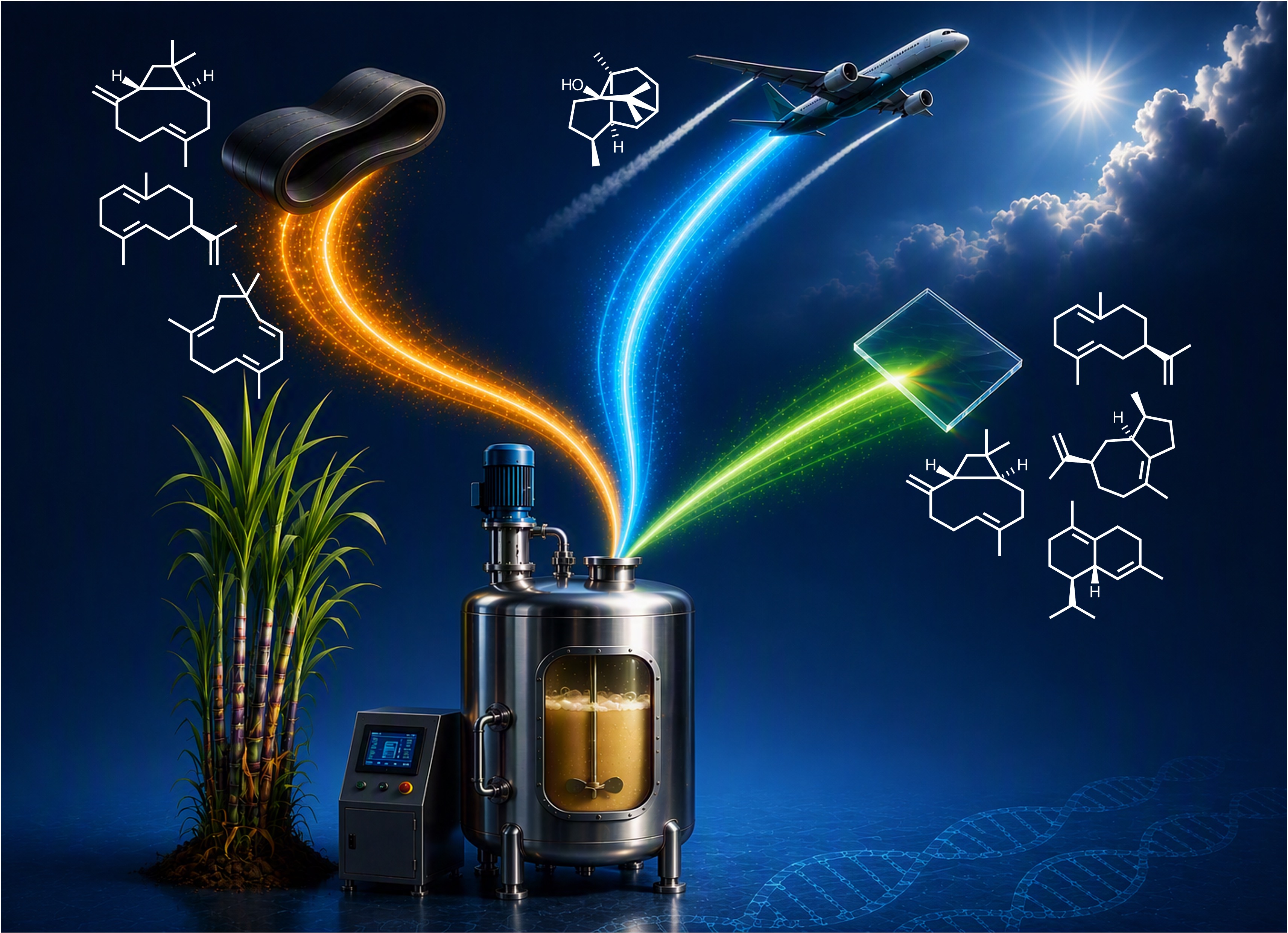
NAWCWD and AFRL then tested six sesquiterpenes across fuel, polymer, and liquid crystal applications. Patchoulane was evaluated as an aviation fuel; caryophyllene, humulene, and germacrene A were explored for their polymerization potential via ring-opening metathesis polymerization (ROMP) and cationic mechanisms; and delta guaiene, delta cadinene, germacrene A and caryophyllene were tested as chiral dopants for cholesteric liquid crystal (CLC) systems. The renewable molecules matched, and in some cases exceeded, the properties of their conventional petrochemical counterparts.
Harvey notes that materials such as these could eventually improve both the performance and sustainability of defense-related applications. For example, said Harvey, "Biosynthetic fuels have the potential to increase the range and performance of both commercial and military jet aircraft while reducing emissions. Elastomers have applications for a myriad of products from solid rocket motors to more mundane components such as tires, seals, gaskets, hoses, and footwear."
Expanding the viable chemical space for sustainable materials design
By linking scalable biosynthesis directly to materials performance, the study expands the viable chemical space for sustainable materials design. "It's exciting to us to leverage our world-leading sesquiterpene platform to enable rapid sample generation for our applications partners at the Navy and Air Force," said Adam Meadows, Director of Data Science at Amyris, and senior author on the study. "Their exploration of new applications and downstream chemistry for this class of biomolecules, combined with Amyris's proven biomanufacturing platform, means that application breakthroughs have a viable manufacturing path to real impact on the world."
The paper's authors see high potential in combining biomanufacturing with synthetic chemistry. As Harvey explains, "We are particularly interested in hybrid approaches that combine synthetic biology with chemical catalysis to develop new materials. This strategy, in combination with AI prediction of fuel/material properties and the use of retrosynthetic algorithms to trace those materials back to readily available biosynthetic precursors, holds the promise of rapidly accelerating material development while reducing costs."
Amyris, NAWCWD and AFRL have collaborated since 2018 on projects funded by DARPA, the Office of the Undersecretary of War for Research and Engineering (OUSW(R&E)) and the Office of Naval Research (ONR), through a cooperative research and development agreement and government contracts. Harvey notes that "Amyris was selected as a partner because of their proven ability to produce high-purity biosynthetic materials at a relevant scale for advanced research and development."
About Amyris, Inc.
Amyris is a vertically integrated biomanufacturing company that creates specialty molecules for a range of industries, including flavors and fragrances, advanced materials, beauty and personal care, food, and more. Using advanced fermentation technology, Amyris customizes, creates, and manufactures ingredients that enhance lives, protect ecosystems, and take products to the next level of performance.
Amyris was founded in 2003 with a bold humanitarian vision to transform access to a life-saving antimalarial compound using biotechnology. Now, with over two decades of proven commercial success, Amyris's proprietary platform is redefining the precision, consistency, and sustainability that is possible with renewable biological chemistry.
For more information, please visit http://www.amyris.com.
Contact: Annie Tsong
Corporate and Scientific Affairs
Tel: +1 510 597 4802