Emeryville, CA, November 10, 2026
By Ninad Kothari, Ph.D.
Key Takeaways
- Quality by Design builds product quality into a process from day one, rather than testing for it at the end.
- Compared with one-factor-at-a-time development, a Quality by Design approach using Design of Experiments can substantially speed up learning, answering the same questions with fewer experiments.
- For partners, this means faster scale-up, lower development risk, and robust manufacturing.
- Amyris is at the leading edge of precision fermentation's evolution into a dependable commercial manufacturing platform, applying the same quality disciplines long relied on in pharmaceuticals and other established industries.
Every company bringing a new ingredient to market knows the risk: a process that performs beautifully in the lab can behave very differently at commercial scale. Beyond being expensive, missed specifications, delays, and rework at that stage also cost time and market opportunity. Having scaled 15 molecules from the lab bench to commercial manufacturing, Amyris has learned firsthand how to create processes that deliver consistently across scales, facilities, operators, and raw material variability.
Bioprocesses are complex. In fermentation, inputs such as temperature, pH, feed rates, and raw materials all shape the final product, and often each other. Purification adds additional complexity, from how impurities are removed to how the product is recovered and finished. Trial and error across all of these steps is slow and unpredictable. Quality by Design offers a more systematic path, from the first fermentation run to the final purified product.
What is Quality by Design?
Quality by Design (QbD) is a systematic approach to development that builds product quality into a process from the start, by understanding which product attributes matter most, which process parameters affect them, and how to keep those parameters under control.
The concept was first outlined by quality pioneer Joseph M. Juran (Yu et al., 2014), who believed most quality problems trace back to how quality was planned in the first place. Juran developed these ideas solving manufacturing quality problems at Western Electric's Hawthorne Works, starting in the 1920s, and later taught them to Japanese industry after World War II, where they became embedded in the country's manufacturing. Quality cannot be tested into a product. It has to be designed in.
The idea became a cornerstone of pharmaceutical development through the ICH Q8(R2) guideline. Outside pharma, we believe QbD remains underused, a missed opportunity for specialty ingredients that demand the same consistency. Amyris is working to change that.
How does Amyris develop with the end in mind?
Our approach starts even before process development: our Cartographer™ platform scores candidate molecules for manufacturability from the outset. Once a molecule is chosen, the next step is product understanding.
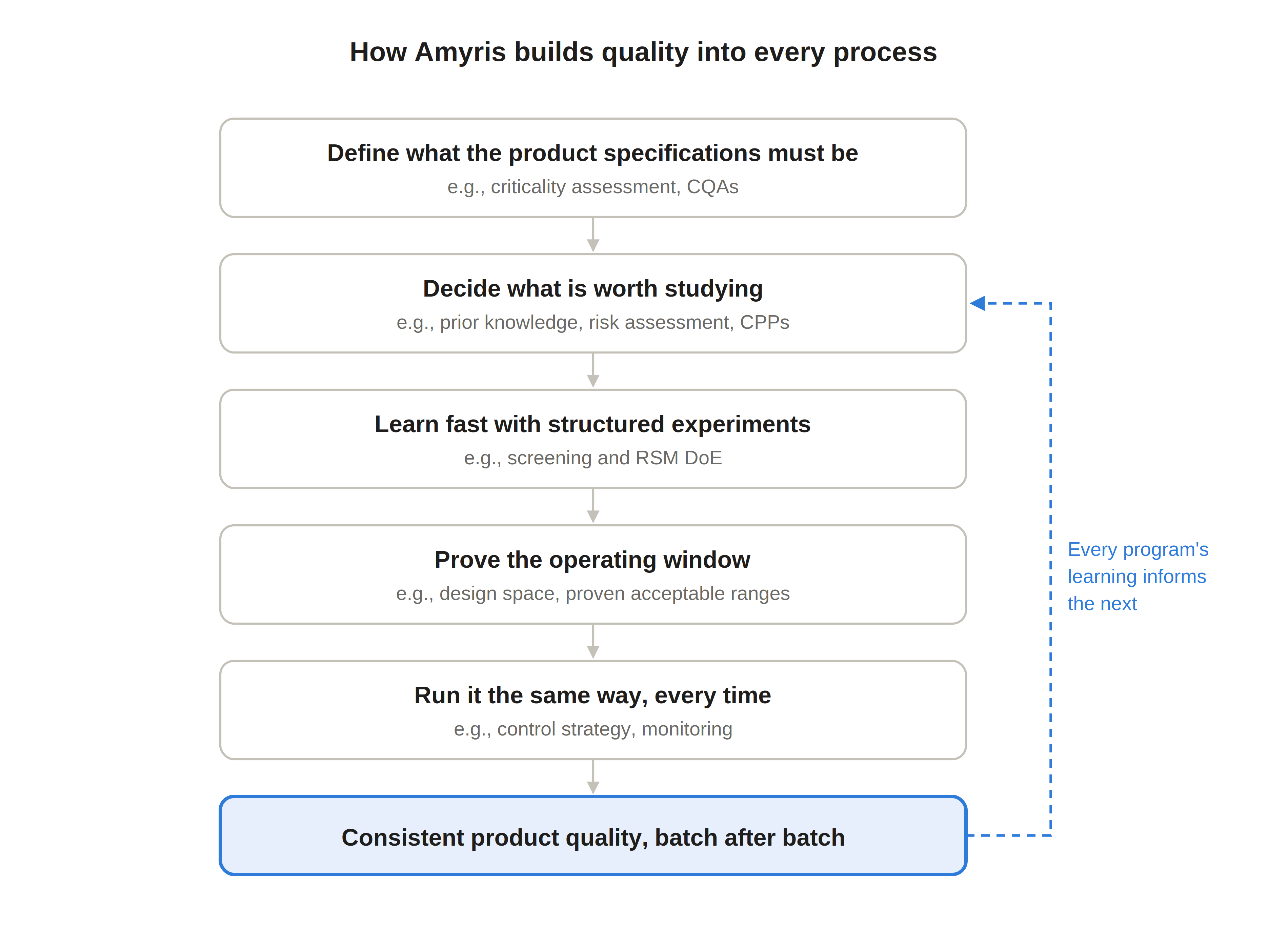
Together with our customers, we define the product specifications, from purity and color to stability and performance in formulation, and determine which attributes have the highest impact on customer adoption. QbD gives this step a formal structure: a criticality assessment that ranks each attribute by the severity and likelihood of its impact to identify the Critical Quality Attributes (CQAs).
We also keep the commercial market in view from day one. Finally, we consider the manufacturing site early and build scale-down models that mirror its conditions, so what we learn at the bench translates faithfully to industrial scale-up, with minimal surprises when a partner's product moves to the plant.
How do you identify Critical Process Parameters?
We prioritize what to study. From fermentation through purification, a process has dozens of inputs that could affect product quality attributes. Amyris has developed fermentation processes for hundreds of microbial strains, and our purification teams feed what they learn about impurities back to our strain engineers. That prior knowledge tells us which inputs carry the most risk.
QbD adds rigor through formal risk assessment, scoring each input on how severely it could affect process performance, product quality, or both, how often it might drift outside its normal operating range, and how readily it would be detected. This separates the few potential Critical Process Parameters (CPPs) from the many that standard best practice can manage, so development time goes where it makes the most difference.
Design of Experiments vs. one factor at a time
The traditional approach to process optimization is one factor at a time (OFAT): change one input while holding the rest steady. Though still useful in some cases, OFAT is slow and has a blind spot: it cannot reveal how factors interact.
Design of Experiments (DoE) varies several factors at once in a structured plan, then uses statistical models to show which factors matter and how they interact. A screening DoE, such as a fractional factorial design, identifies the parameters that drive performance and quality, and a Response Surface Methodology (RSM) DoE then maps them across the studied range to pinpoint where the process performs best. When we already know a system well, a definitive screening design (DSD) can often do both in a single, compact study.
Compared with OFAT, this approach can answer the same questions faster, with substantially fewer experiments, while generating more information and greater statistical confidence (Mandenius & Brundin, 2008; Kumar et al., 2014).
What is a design space?
The result of process characterization is a design space: the proven acceptable range for each critical parameter, with a narrower normal operating range set inside it, informed by both the data and the manufacturing site's operational capability. Think of it like the mix of light and water that keeps a plant healthy: too little or too much of either, and it struggles.
For partners, that means answers sooner and a process that is truly understood, not just optimized.
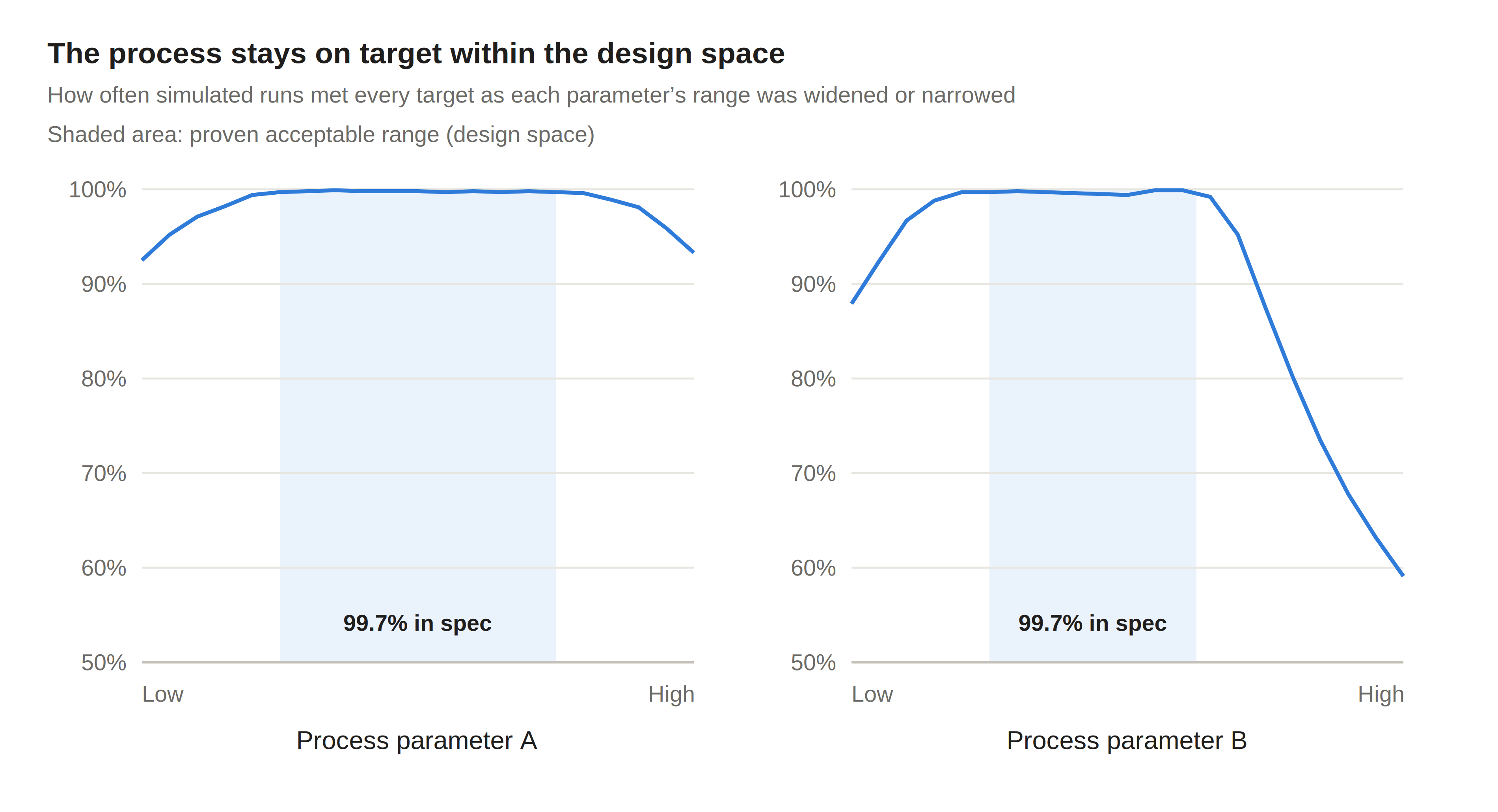
The design space shown above is based on a simulation built on the study's statistical model: 99.7% of simulated runs inside the proven acceptable range met every target. Widen parameter B's range past its upper limit, and that share drops quickly. The targets cover process performance as well as product quality.
Building a control strategy
A control strategy turns process understanding into something a manufacturing team can run batch after batch. It sets clear operating targets and boundaries for each critical parameter, defines what to monitor most closely, and sets out how to respond if conditions begin to drift.
When operating targets sit inside proven ranges, the process can absorb real-world variation: seasonal changes, a new lot of raw materials, a different facility. That makes technology transfer smoother and more predictable. At our Barra Bonita facility, more than one billion data points a day help keep production on target in real time.
"From the operational excellence side, QbD maps naturally onto the Design for Six Sigma method we use for new processes. That gives Process Development and manufacturing a shared language and a clear deliverable at tech transfer."
Fabiano de Souza, Senior Technology Manager, Amyris
What this means for our partners
Quality by Design builds on strengths long core to how Amyris scales precision fermentation, giving that experience a structured, data-driven framework. Whether you are investing in a new technology, looking for a scale-up accelerator, or seeking a manufacturing collaborator, the result is faster scale-up, lower development risk, robust manufacturing, and consistent product quality in every batch.
Quality by Design reflects a broader shift. As biomanufacturing adopts the same proven quality principles that other manufacturing sectors rely on, it is becoming a mature commercial platform that partners can build on with confidence. Amyris is setting that standard.
"Our goal is to make best practice standard practice. The earliest decisions in process development shape speed, consistency, and manufacturability. Quality by Design helps us get them right from the start, so our partners reach the market faster, with consistent quality they can count on at scale."
Ninad Kothari, Ph.D., Scientist, Amyris
Frequently asked questions
How is Quality by Design used outside pharma?
QbD's principles apply to any process where consistent quality matters. In industrial biotech, they help design precision fermentation processes that scale reliably and deliver specialty ingredients that meet both quality and performance targets.
What is a design space?
A design space is the range of process conditions proven to deliver product that meets every target. Operating inside it gives confidence in consistent quality and performance; moving outside it raises the risk of falling short.
How does Quality by Design support technology transfer?
QbD documents which parameters matter, their proven ranges, and how to control them. A receiving manufacturing site gets a clear, data-backed process definition rather than a fixed recipe, which makes transfers smoother and more predictable.
Does Quality by Design mean running more experiments?
No. Design of Experiments typically answers the same questions with substantially fewer experiments than testing one factor at a time, because each run provides information about several factors at once.
Have a molecule you're ready to scale? Let's talk about how Quality by Design can get it to market faster, with quality you can count on.
About the author

Ninad Kothari, Ph.D., is a scientist on Amyris' fermentation team with more than eight years of experience in fermentation process development. Ninad leads the development of a platform approach to fermentation process design and champions Quality by Design principles in fermentation. He holds a Ph.D. in Chemical and Environmental Engineering from the University of California, Riverside.